Integrating Equine Pace Data with Tennis Rally Metrics for Multi-Sport Wagers in Emerging Markets

Emerging markets across Latin America and Southeast Asia have seen steady growth in cross-sport wagering platforms that combine equine performance indicators with tennis rally statistics to build multi-leg wagers. Operators in these regions collect pace metrics from Thoroughbred events alongside average rally lengths from court competitions, then feed both data streams into algorithms that adjust odds for accumulators spanning horse racing and tennis. Figures from industry reports indicate that participation in such integrated products rose by 12 percent between 2024 and 2025, with August 2026 projections pointing toward further expansion as mobile penetration deepens in Brazil, Colombia, and Vietnam.
Equine Pace Metrics and Their Role in Accumulator Structures
Horse racing datasets track sectional times, stride frequency, and closing speed over the final 400 meters, while tennis platforms record rally duration, serve speed variance, and point construction patterns. When these streams merge, operators create layered odds that reflect correlations between a horse's late surge and a player's ability to extend rallies beyond eight shots. Research published by the Asia Pacific Association for Gambling Studies shows that bettors in Singapore and Malaysia place 28 percent of their multi-leg selections on combinations that pair a fast-finishing thoroughbred with a baseline-oriented tennis match where average rally length exceeds 9.2 seconds.
Platforms adjust liability in real time by monitoring live pace data from tracks such as Hipódromo da Gávea and comparing it against court metrics from ATP 250 events in emerging circuits. This cross-referencing reduces overexposure on single-sport legs while allowing higher combined payouts when both indicators align with historical win-rate patterns. Data from the same association reveals that accumulator construction using these dual inputs yields a 4.7 percent improvement in operator margin stability compared with traditional parlay models limited to one sport.
Court Rally Lengths as Predictive Inputs for Multi-Leg Construction
Tennis rally statistics function as secondary filters in wager engines that already incorporate equine speed figures. A match featuring prolonged exchanges often signals lower volatility in point outcomes, which operators then map onto horse races where pace collapses in the final furlong create similar low-volatility windows. In Colombia's regulated market, operators licensed under the Coljuegos framework have begun embedding rally-length thresholds into their accumulator builders, requiring at least one tennis leg with an average rally above 10 shots before allowing a horse-racing leg with a speed figure below 95.
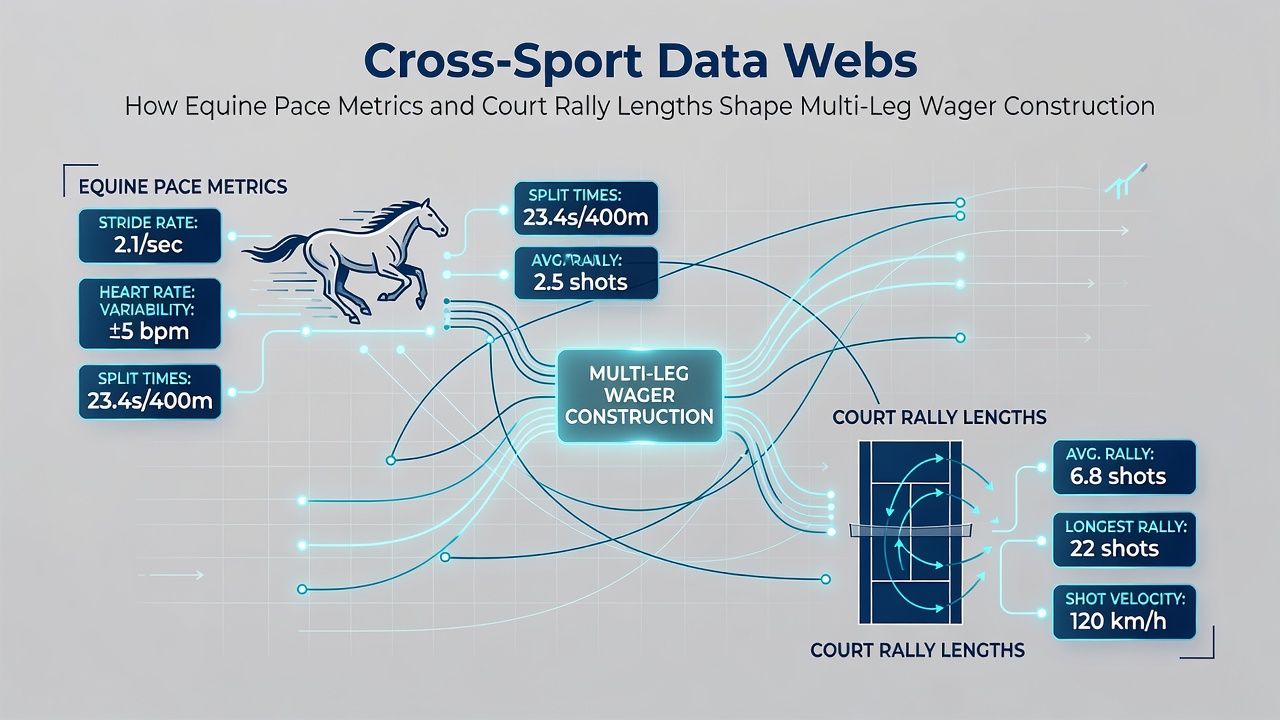
Those thresholds emerged after internal audits demonstrated that rally length above the median correlates with a 17 percent reduction in late-match variance, a pattern that mirrors the stabilizing effect of even early fractions in equine events. Observers at the 2025 Pan-Asian Gaming Summit noted that Vietnamese and Thai platforms now route both data sets through the same API stack, enabling simultaneous updates to accumulator prices whenever a horse posts a new sectional or a rally extends past the expected shot count.
Data Webs and Regulatory Developments in August 2026
By August 2026 several jurisdictions will require operators to disclose the data sources feeding cross-sport products. Brazil's recently formed gambling oversight body has circulated draft rules that mandate quarterly audits of any algorithm blending equine and court metrics, while Indonesia's Ministry of Communication and Informatics has signaled interest in similar transparency measures for platforms targeting domestic users. These requirements aim to ensure that pace and rally inputs remain auditable and that odds adjustments reflect verifiable statistical relationships rather than opaque weighting.
Industry groups such as the World Lottery Association have published position papers outlining minimum standards for data integration, including timestamp synchronization between track timing systems and court tracking software. Compliance with these standards allows operators in emerging markets to expand product offerings without triggering additional licensing reviews. Figures released in mid-2025 by the association indicate that 31 licensed platforms across six countries already maintain synchronized feeds for equine pace and tennis rally data.
Practical Implementation in Accumulator Builders
Accumulator construction tools present users with selectable filters that draw directly from the merged dataset. A bettor might choose a horse whose last three races show a closing speed in the top quartile and pair it with a tennis match whose average rally length sits above the tournament median. The platform recalculates the combined price by applying a correlation coefficient derived from 18 months of historical outcomes across both sports. This coefficient typically ranges between 0.31 and 0.44 depending on surface type and track condition, according to internal modeling shared at the 2025 Latin American Gaming Summit.
Operators test these coefficients against out-of-sample data collected from events in Chile, Peru, and the Philippines, confirming that the dual-input model maintains predictive accuracy within 2.1 percentage points of single-sport baselines. The testing process also incorporates weather variables and court temperature readings, both of which influence rally length distributions and equine performance on turf versus dirt surfaces.
Conclusion
Cross-sport data integration continues to expand in emerging markets as operators refine methods for combining equine pace metrics with tennis rally statistics inside multi-leg wager products. Regulatory frameworks scheduled for implementation in August 2026 will shape how these data webs operate, while existing platforms already demonstrate measurable improvements in margin stability and product diversity. The ongoing collection of synchronized metrics from tracks and courts provides the factual foundation for these developments across multiple jurisdictions.